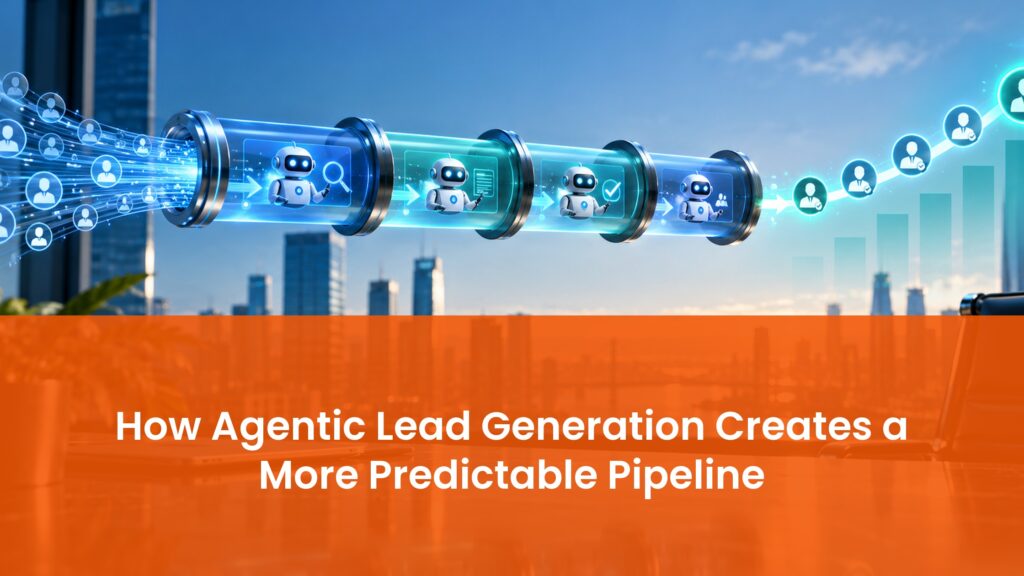
Lead generation becomes difficult to manage when every stage depends on manual effort. Research happens inconsistently, follow-ups are missed and prospect information is scattered across tools. The pipeline may grow during an intensive campaign, then slow as soon as the team turns its attention elsewhere.
Agentic lead generation addresses this operational problem. Instead of using AI only to write messages, businesses can deploy coordinated AI agents to complete defined tasks, move information between systems and prompt humans when judgment is required.
What makes a lead generation system agentic?
A conventional automation follows a fixed instruction: when one event happens, perform one action. An agentic workflow can evaluate available information, select an appropriate next step and complete a sequence of tasks within established boundaries.
For example, an agent might review a target account, identify relevant decision-makers, summarise recent business signals and prepare a research brief. A separate agent could classify replies, update the CRM and notify a salesperson when a response meets agreed qualification criteria.
Create continuity across the pipeline
Predictability does not mean guaranteeing a certain number of leads. It means building a process that operates consistently and produces information you can use to make better decisions. Agentic systems help by reducing the gaps between prospecting stages.
- Research: Collect and structure useful account and contact information.
- Prioritisation: Rank prospects using fit criteria and relevant intent signals.
- Outreach support: Prepare message angles based on the prospect’s likely priorities.
- Follow-up: Schedule appropriate actions while respecting campaign rules.
- Qualification: Categorise responses and surface opportunities for human review.
- Reporting: Summarise activity, conversion points and pipeline bottlenecks.
Keep humans at the decision points
An effective system does not allow an agent to make every decision independently. Sensitive communication, unusual objections, pricing discussions and strategic account choices should remain under human control. The agent handles repeatable work and presents organised context; the team applies judgment.
This division of responsibility improves efficiency without creating avoidable brand risk. It also makes adoption easier because team members can see where AI contributes and where their expertise remains necessary.
Design around clear inputs and rules
Agentic lead generation will not repair an unclear commercial strategy. Before automating, define the ideal customer profile, offer, qualification standards, approved channels and conditions for human intervention. Agents need reliable data and explicit operating rules.
Start with one contained workflow rather than attempting to automate the entire revenue operation. Account research, inbound lead routing or follow-up administration can provide a practical starting point. Measure whether the workflow saves time, improves data quality or reduces missed actions before expanding it.
Measure business movement
Activity metrics alone can create a false sense of progress. A stronger measurement framework examines qualified response rates, speed to follow-up, progression between pipeline stages, meeting quality and reasons opportunities are rejected.
These measures help your team identify whether the system is reaching suitable companies and creating commercially relevant conversations. They also provide the feedback needed to refine prompts, rules, data sources and human handoffs.
Agentic lead generation is most valuable when it becomes part of a well-designed revenue system. The result is not a fully autonomous sales department. It is a more disciplined operation in which routine work continues, useful signals reach the right people and pipeline decisions are based on clearer information.