Random outreach usually begins with activity rather than strategy. A team collects a list, sends generic connection requests and follows up until someone responds. The volume may look productive, but the resulting conversations are often inconsistent, poorly qualified and difficult to convert.
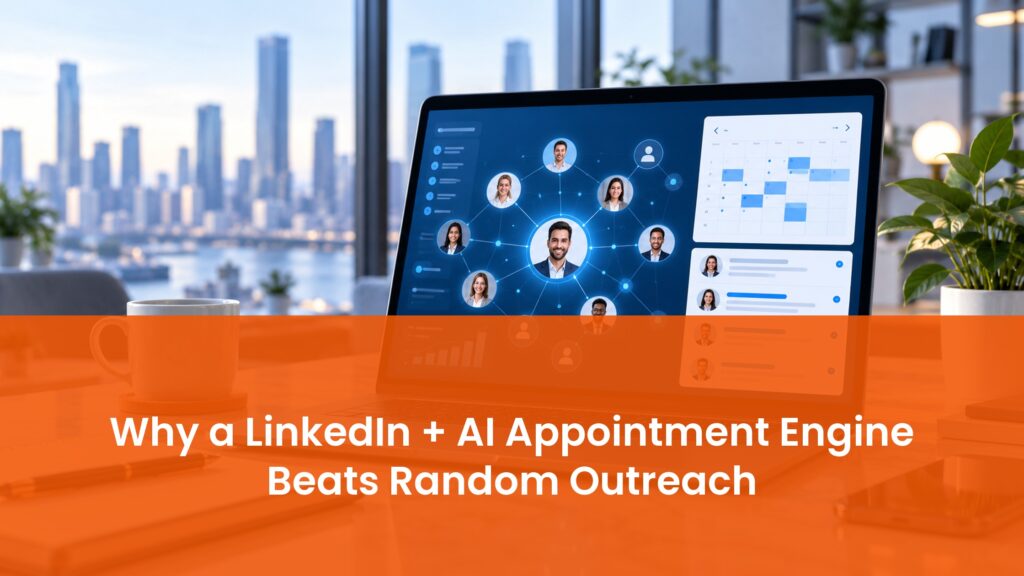
A LinkedIn + AI Appointment Engine takes a different approach. It connects targeting, positioning, content, outreach, qualification and follow-up in one coordinated system. The objective is not to send more messages. It is to create relevant conversations with people who have a credible reason to consider your offer.
Start with a commercially useful audience
Strong outreach depends on a precise ideal customer profile. That includes company type, size, market, decision-maker role, business priorities and likely buying triggers. When these criteria are clear, your team can build smaller, better prospect segments instead of approaching anyone who loosely matches a job title.
AI can support this process by researching accounts, organising prospect data and identifying relevant signals. Human judgment is still essential. A promising signal must be interpreted in the context of your offer, the prospect’s responsibilities and the problem you solve.
Coordinate content and conversations
Prospects rarely evaluate a LinkedIn message in isolation. They may visit your profile, review recent posts and look for evidence that you understand their situation. Your positioning and content therefore need to support the outreach campaign.
Useful content can explain the cost of an unresolved problem, challenge a common assumption or show how a better process works. This gives prospects context before a direct conversation begins and helps your outreach feel like a logical extension of your expertise.
Use automation without sounding automated
Automation is valuable when it handles repetitive coordination rather than replacing relevance. An effective appointment engine can support tasks such as:
- Organising prospects into defined campaign segments
- Tracking connection and follow-up stages
- Generating research briefs and message starting points
- Alerting a team member when a prospect shows intent
- Routing qualified replies into a CRM or booking workflow
The final message should still reflect the prospect’s context. AI-generated personalisation is not useful if it simply mentions a recent post and jumps into a pitch. Relevance comes from connecting a genuine business observation to a problem your service can solve.
Build follow-up around buyer readiness
Random outreach often treats silence as a signal to send the same message again. A structured engine uses different follow-ups to add context, answer likely questions and make the next step easier. It also recognises when to pause rather than pursuing a prospect indefinitely.
Not every positive response should immediately become a sales call. Simple qualification questions can establish whether there is a relevant need, suitable timing and a realistic fit. This protects your calendar and creates a better experience for the prospect.
Measure the system, not just message volume
A useful appointment engine tracks movement through the complete journey: audience quality, connection acceptance, meaningful replies, qualified conversations, booked calls and sales opportunities. These signals show whether the problem sits in targeting, messaging, positioning, follow-up or qualification.
The advantage is operational clarity. Instead of relying on occasional bursts of outreach, you develop a repeatable process that can be reviewed and improved. AI increases the team’s capacity, while strategy and human judgment keep the system commercially relevant.
If your LinkedIn activity is generating motion without enough qualified conversations, the next step is to examine the complete appointment journey.