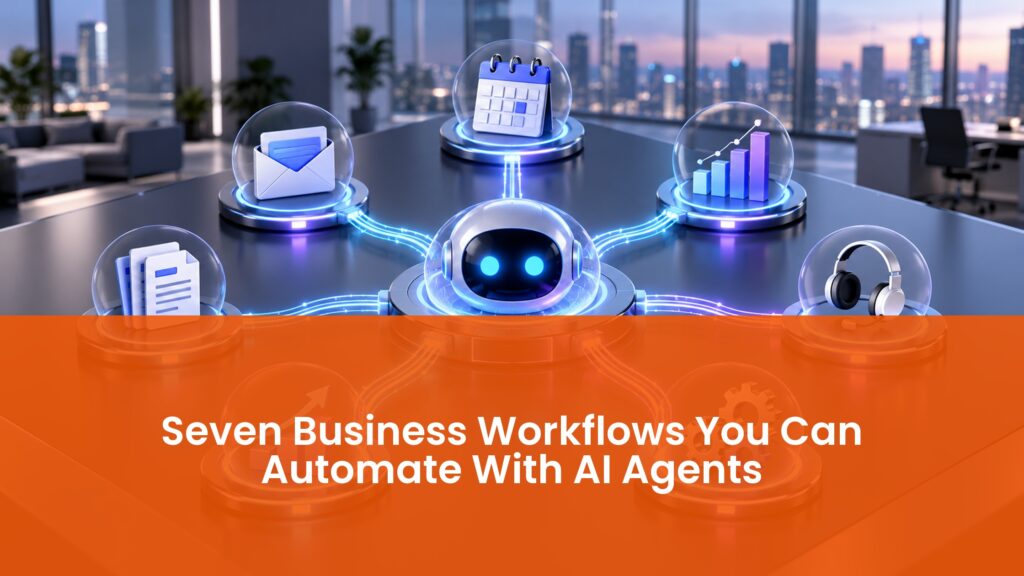
AI agents are most useful when they solve a defined operational problem. Asking an agent to “help with marketing” is too broad. Giving it approved data, clear rules and responsibility for a specific workflow creates a result that can be tested and improved.
The following workflows offer practical starting points for B2B companies, consultants and service providers. Each should include human oversight, access controls and an escalation path for situations the agent should not handle alone.
1. Prospect and account research
An AI agent can collect approved public information about target companies, organise it against your ideal customer profile and prepare concise account briefs. It can highlight factors such as market focus, current initiatives, likely decision-makers and relevant business signals. Your sales team can then spend less time gathering basic information and more time interpreting it.
2. Lead qualification and routing
When an enquiry arrives, an agent can assess the information against agreed qualification criteria. It might classify the lead by service need, company fit, urgency or location before updating the CRM and assigning the next action. Ambiguous or high-value enquiries can be routed to a person for review rather than processed automatically.
3. Personalised outreach preparation
Agents can turn account research into message drafts or talking points for LinkedIn and email outreach. The objective should not be superficial personalisation. A useful draft connects a credible observation with a relevant problem, question or resource. A human can review the message before it is sent, particularly for strategic accounts.
4. Content repurposing
A webinar, interview or long-form article can support several smaller assets. An agent can extract key themes and prepare drafts for social posts, emails, sales enablement notes and frequently asked questions. Brand guidelines and an approval stage help maintain consistency and prevent unsupported claims from reaching the audience.
5. Meeting preparation and follow-up
Before a meeting, an agent can assemble relevant CRM records, previous communications and account notes into a briefing. Afterward, it can structure approved notes, identify action items and draft a follow-up email. This reduces administrative delay and makes it easier to maintain momentum without relying on memory.
6. Customer support triage
An agent can categorise incoming support requests, locate relevant material from an approved knowledge base and suggest a response. Routine questions can move through a controlled process, while complaints, technical uncertainty or commercially sensitive issues are escalated. This supports faster organisation without pretending that every problem has a simple automated answer.
7. Management reporting
Business data often sits across advertising platforms, CRM systems, spreadsheets and project tools. An agent can retrieve authorised information, standardise it and produce a regular summary of performance, bottlenecks and outstanding actions. Decision-makers receive a clearer view without someone rebuilding the same report each week.
Choose the first workflow carefully
The best first automation is usually frequent, rules-based and time-consuming, but not highly risky. Map its current steps, identify the systems involved and decide where human approval is required. Then test it on a limited scope using realistic examples.
Useful success measures include time saved, fewer missed actions, improved data completeness and faster response times. Review output quality as well as efficiency. A workflow that produces more work for reviewers has not been automated effectively.
AI agents can create meaningful operating leverage, but only when they are designed around the way your business actually works. Start with a clear process, establish boundaries and expand after the first workflow performs reliably.

