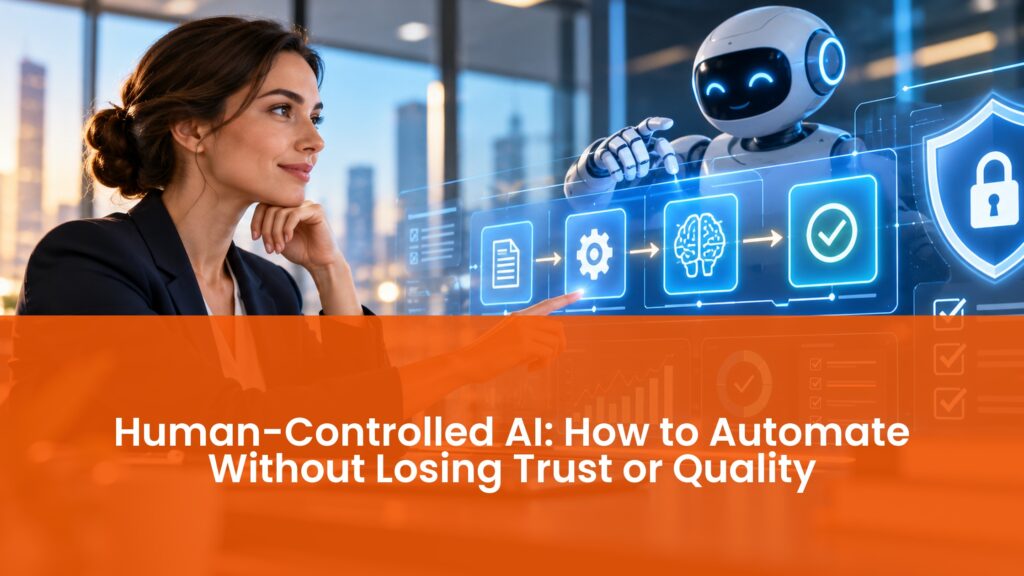
AI can help businesses research accounts, draft content, prioritise leads, summarise conversations and coordinate follow-up. It can also produce inaccurate information, impersonal communication and inconsistent decisions when it is deployed without clear controls.
Human-controlled AI offers a more practical model. Automation handles suitable tasks at speed, while people retain authority over strategy, sensitive communication and consequential decisions. The goal is not to keep a person manually involved in every step. It is to place human judgment where errors could damage trust, quality or commercial outcomes.
Decide what AI is allowed to do
Start by separating tasks according to risk and repeatability. Structured, reversible work is often easier to automate than ambiguous or customer-facing decisions.
- Automate: data formatting, tagging, reminders, transcript summaries and routine reporting.
- Review before release: personalised outreach, proposals, strategic recommendations and public content.
- Keep human-led: negotiation, sensitive complaints, final hiring decisions and commitments involving legal or financial risk.
The exact boundary depends on your business, data and customers. Document it so the team knows when approval is mandatory and when the system can proceed independently.
Give the system reliable context
AI output quality depends heavily on the information and instructions available. Connect agents only to approved sources, define the audience and objective, and provide examples of acceptable work. A model should not invent a customer result, product capability or personal detail simply because the prompt asks for persuasive language.
For revenue workflows, maintain clear CRM fields, offer documentation, qualification criteria and messaging guidelines. Better operational data reduces the temptation to fill gaps with assumptions.
Design approval around risk
Human review should be specific rather than ceremonial. Tell reviewers what to check: factual accuracy, relevance, tone, privacy, brand fit and the appropriateness of the next action. Higher-risk outputs may require named approval, while low-risk work can be sampled through periodic quality checks.
Make it easy to reject, edit or pause an automated action. If a workflow can send messages but cannot be stopped quickly, it is not under meaningful human control.
Protect the customer experience
Efficiency should not come at the cost of relevance. Avoid large-scale personalisation that pretends to know more about a prospect than it does. Use AI to support research and drafting, then ensure messages are appropriate to the relationship and channel. When a person responds, route the conversation to someone who can understand nuance and take responsibility.
Monitor outcomes and failure patterns
Track more than time saved. Review correction rates, customer responses, escalation frequency, false qualification and missed opportunities. Keep logs of important automated actions and investigate recurring errors. A workflow that creates additional cleanup or weakens response quality is not delivering useful efficiency.
Introduce AI in controlled stages. Test with internal tasks, use a limited audience, compare results with the existing process and expand only when the controls work. Assign an owner who is responsible for performance, documentation and updates as tools or business rules change.
Human-controlled AI is not slower automation. It is accountable automation: systems do the repeatable work, and people protect judgment, relationships and standards. If you want to identify safe, commercially useful AI workflows across marketing and sales, start with a clear process and control map.

