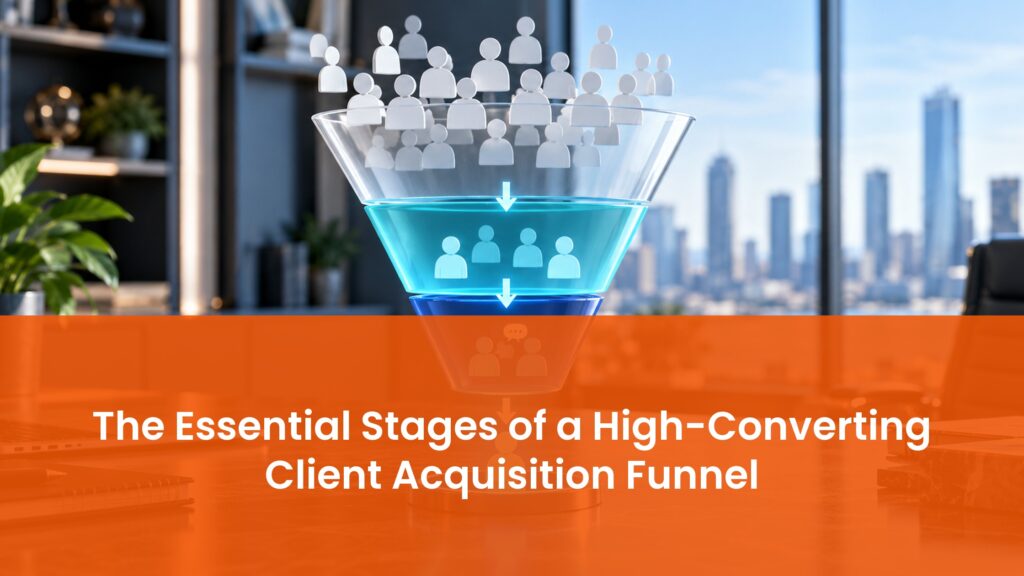
A client acquisition funnel is not simply a landing page followed by a sales call. It is the connected system that moves a suitable prospect from initial awareness to a confident buying decision. When the stages are designed separately, leads get lost, follow-up becomes inconsistent and teams struggle to identify what needs improvement.
For B2B services and technology offers, a high-converting funnel should prioritise relevance and progression over maximum volume. The aim is to create enough clarity and trust for qualified buyers to take the next appropriate step.
1. Market focus and offer definition
Every effective funnel starts before traffic generation. Define the organisations and decision-makers you can help, the costly problem they recognise and the service or solution that addresses it. Clear positioning gives every later stage a consistent message and prevents budget being spent attracting poor-fit enquiries.
2. Demand creation and discovery
Prospects need a credible way to discover your point of view. Depending on the market, this may involve LinkedIn content, targeted outreach, search-led articles, partnerships, email or paid campaigns. Channel selection should reflect where buyers seek information and how much education the offer requires.
The message should connect a real business issue with a useful perspective. Generic visibility may increase impressions without increasing buying interest.
3. Interest capture
Once attention is earned, offer a next step that matches the prospect’s readiness. This could be a practical guide, assessment, event, service page or direct consultation. The landing experience should explain the value, intended audience and expected outcome without creating unnecessary form friction.
4. Nurture and consideration
Many B2B prospects need time to understand options, involve colleagues and assess risk. Email sequences, retargeting, useful content and thoughtful human follow-up can support that process. Effective nurture answers buying questions and demonstrates expertise; it does not repeat the same sales request every few days.
5. Qualification and routing
Not every lead belongs in the same sales process. Define qualification around factors such as fit, problem, priority, decision process and ability to implement. Use automation to capture and route information, while keeping human review for nuance. Clear CRM stages and ownership rules stop promising opportunities from being delayed or mishandled.
6. Sales conversation and decision support
The sales stage should continue the promise made earlier in the funnel. Discovery should clarify the buyer’s situation rather than force a scripted pitch. Proposals, demonstrations and follow-up should connect the recommended approach to agreed needs, explain responsibilities and make trade-offs visible.
7. Onboarding, feedback and optimisation
Acquisition does not end at signature. A clear handover protects trust and gives delivery teams the context gathered during sales. Over time, compare channel, lead, meeting, opportunity and customer data to locate constraints. A low conversion rate may reflect the wrong audience, weak follow-up or an offer mismatch rather than a landing-page problem.
The best funnel is not the most complicated. It is the one your team can operate consistently, measure honestly and improve deliberately. If your current journey contains disconnected campaigns or unclear handoffs, mapping these stages can turn scattered activity into a practical revenue system.

